From 3-6 July 2023, some of our team were lucky to attend the Memory Studies Association conference, which was conveniently held in Newcastle-upon-Tyne, and discuss some of our findings so far.
Attending the conference were our project Research Fellows Ann-Marie Foster and Chris Kempshall, Co-Investigator Tony Williams, our freelance Creative Writing practitioner Felicity Tattersall, and project lead Ann-Marie Einhaus. As part of the conference, we individually saw a lot of excellent panels and presentations that will feed into our own thinking about war, cultural heritage, community and memory. However, we also got to talk about our own work and think out loud about ephemera in the form of a roundtable conversation.

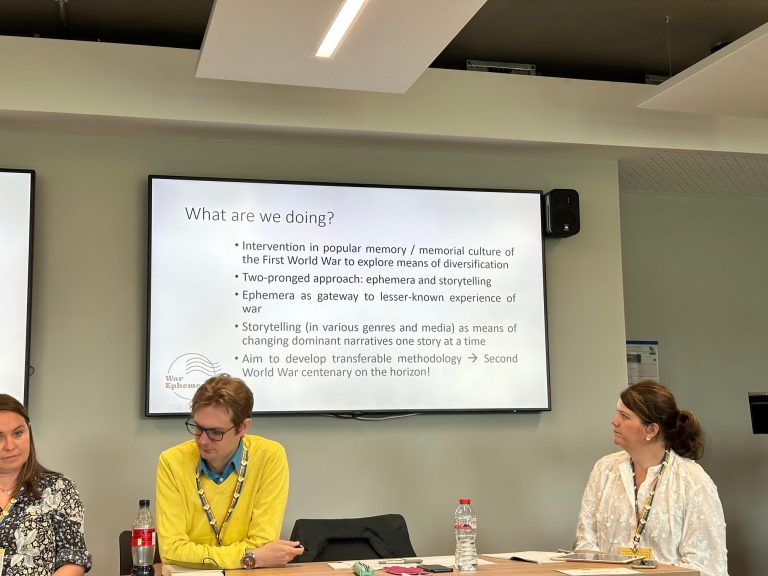
The roundtable took place on Wednesday, 5 July, and was expertly chaired by Dr Alexandra Peat, currently a British Academy-funded Visiting Fellow at Northumbria University. Alexandra’s own research interests in literature, ephemera and migration were an ideal complement to our project. We started the roundtable session with a quick project overview and introductions of panel and chair, before moving on to respond to a series of questions, and finally opening up the conversation to our audience, too.
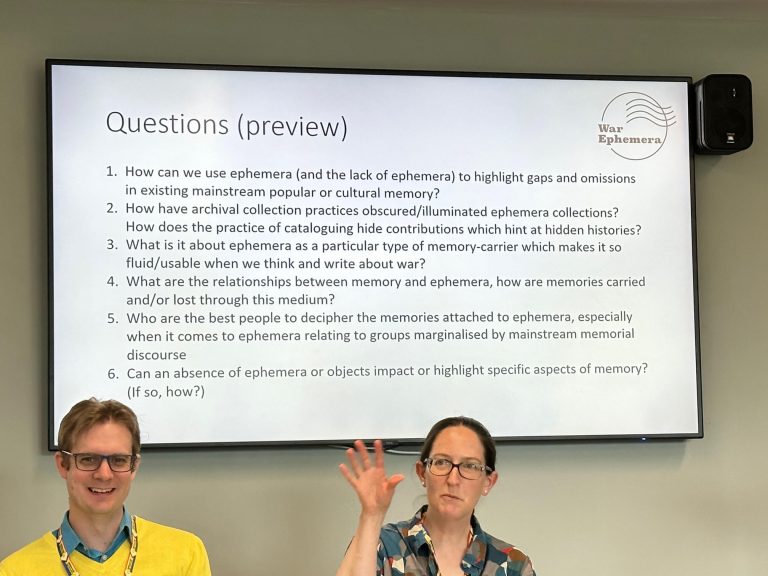
Question 1: How can we use ephemera (and the lack of ephemera) to highlight gaps and omissions in existing mainstream popular or cultural memory?
Ann-Marie E. took the lead in answering this question as she had proposed it in light of her project research on postcolonial historical fiction about the First World War (which is still represented by a very small number of texts). She gave a brief overview of how novels like Abdulrazak Gurnah’s Afterlives (2020) are structured around the lack of ephemeral items to illuminate colonial war experience, arguing that such texts specifically highlight what we don’t and perhaps can’t know. Ann-Marie E. also raised the questions of whether British preoccupation with war ephemera is largely a Western phenomenon, and how far that is connected with Western understanding of literacy and the literary.
On the project team, Co-Investigator May Sumbwanyambe is setting out to reconstruct Black British First World War experience through the insights offered by periodicals, but many gaps remain, and it remains an ethical challenge to fill in these gaps – as articulated, for instance, by Saidiya Hartman’s thoughts on critical fabulation. In response, Tony shared his decision not to write a historical novel, but to experiment with a fantasy approach instead. We noted that especially in the British context, the main challenge is not a lack of ephemera but rather a lack of diversity of objects. This leads to a lack of diversity of stories as everyone is drawing on the same material because that is what writers, artists, video game makers etc. can access in representing the First World War.
Question 2: How have archival collection practices obscured/illuminated ephemera collections? How does the practice of cataloguing hide contributions which hint at hidden histories?
In response, Chris reminded us that ephemera is often not taken seriously: it is all too often the stuff, as Alexandra chimed in, that we happen to find when we are really looking for something else. If we do want to search for ephemera on purpose, the challenge is how we can do this when (as Ann-Marie F. pointed out) ephemera are mostly not properly catalogued, or mislabelled, including in miscellaneous, digital archives where ephemeral items ‘donated’ by the public are labelled as ‘stories’ and thus dismissed as halfway fictional. Even where cataloguing occurs, there is also the challenge of how (well, thoroughly, accurately) the catalogue describes an artefact. As Ann-Marie E. added, this is one of the roles of historical fiction – to find obscure objects and stories and bring them to the public eye.
Question 3: What is it about ephemera as a particular type of memory-carrier which makes it so fluid/usable when we think and write about war?
As we tackled this question, we variously noted the sheer variety, flexibility, and emotional staying power of ephemera – though as Ann-Marie F. pointed out, we naturally drifted towards thinking of personal ephemera rather than their cousins generated by institutions (since official pamphlets, posters and reports tend not to have the same affective impact as personal documents and objects). We did agree, though, that there is something about the fragmentary and material nature of ephemera that helps us approach inaccessible memories – ephemera can be both a memory bridge and point to/materialise the gap between knowing and not-knowing. In short, there is an ambivalent quality about ephemera –they are both evocative and bland (when decontextualised).
Question 4: What are the relationships between memory and ephemera, how are memories carried and/or lost through this medium?
We agreed in our discussion that the ephemeral object often stands in for trauma – there is meaning invested not only in the object but also in how the object has been communicated, kept, stored, or passed on. We also reminded ourselves that it is important to keep in mind that forgotten is not the same as suppressed, lost is not the same as dismissed.
Question 5: Who are the best people to decipher the memories attached to ephemera, especially when it comes to ephemera relating to groups marginalised by mainstream memorial discourse?
We started off discussing Chris and Felicity’s work with members of the public and community groups, both as part of the project and in their previous work. Both see one role of the project as facilitating people whose stories have been obscured and give them power them to tell them – or not to tell (or share) them of that is what they prefer. Given the still overwhelming dominance of white and/or middle-class voices in institutions and industries that transmit stories and knowledge about the past (publishing, galleries, museums, archives), Ann-Marie E. shared her decision to focus only on authors of postcolonial fiction about the war experience of colonial soldiers and civilians who themselves have links to the relevant communities.
Question 6: Can an absence of ephemera or objects impact or highlight specific aspects of memory? (If so, how?)
To begin with, our chair Alexandra noted the irony inherent in the fact that our discussion began and ended not with ephemera itself but the absence of ephemera. An absence of ephemera can be an invitation to re-imagine, one fraught with challenges but also enabling. It is also in keeping with the fact that by definition, as Ann-Marie F. reminded us, ephemera is not supposed to last – ephemera are always transient, disintegrating, and their story is usually a story of loss: the history of ephemera, including prominently war ephemera, is always tied to the history of their destruction. Most are deliberately destroyed as they become obsolete (e.g. the pulping of outdated public health leaflets or surplus magazine numbers), which means we are lucky to find what we do find since ephemera are often preserved by chance rather than by choice. The way in which ephemera are destroyed can also reveal economic and social history – e.g. melting down of First World War medals for money in 1930s, destruction of paper material to combat infestations. In the very fact that ephemera are easily lost, destroyed or decontextualised, however, Ann-Marie E. sees a metaphor for the nature of (individual and collective) memories.
After this point, we opened up the discussion to our small but engaged audience, who raised some great additional questions. A question about differences between ephemera and other objects helped us clarify our own (very broad) definition of ephemera, which includes photographs (but we also talked about the way photos in particular can be like icons, in that they stand in for a particular person, or potentially the idea of a person).
Next up, we were asked about the importance of genre (e.g. horror) in writing about war based around ephemera. This gave Ann-Marie E. the chance to talk a bit about her thinking around connection between poetic form and ephemera, and the fact that literary texts start out in ephemeral form – and in some instances (e.g. the poem or story published in a magazine) end as ephemera, too.
Last but not least, we also discussed the potential significance of project’s research for more recent/ongoing conflicts, and the danger of wanting to ‘discover’ the obscure. We agreed that much of our thinking about the role of ephemera in representing war (including through literary and other storytelling media) is likely to be useful and relevant for any modern conflict, albeit with added challenges in an age of ‘born digital’ ephemera. We also agreed, as a concluding point, that it is important for projects like ours to pursue a methodology that is not hellbent on bringing ephemera into the mainstream, as that would rob it of many of its particular characteristics.
At any rate, we agreed, mainstream commemoration of the First World War in Britain is pretty robust, and even the centenary programme has made only small dents into the overall picture.