Designing out economic abuse in the UK banking industry
Project summary
Perpetrators of economic abuse are misusing the financial products, services and technologies provided by banks in order to cause harm to their intimate partners. Examples include fraudulently opening credit cards in their victim’s name, withdrawing cash from joint accounts without their consent, using real-time transaction notifications to stalk them, and sending unwanted or abusive messages via online payment descriptions.
Financial service providers are starting to take notice and are implementing initiatives to tackle economic abuse. However, these initiatives, although welcome, are mostly reactive, focusing on minimising harm after abuse has already occurred.
In this project, we take a proactive stand against economic abuse by identifying and proposing ways of radically reconfiguring the banking features that abusers use to their advantage, and by envisioning new functionality that can prevent abusive behaviour. We are looking to end economic abuse and prevent people misusing financial products. In close collaboration with banking professionals and under the design leadership of victim-survivors, the project uses participatory design methods to revisit how banking services and technologies are designed, and will produce a key set of recommendations for designing out economic abuse from banking products.
Full project title
Designing Out Economic Abuse in the UK Banking Industry: A Participatory Design Project with Victim-Survivors and Banking Professionals
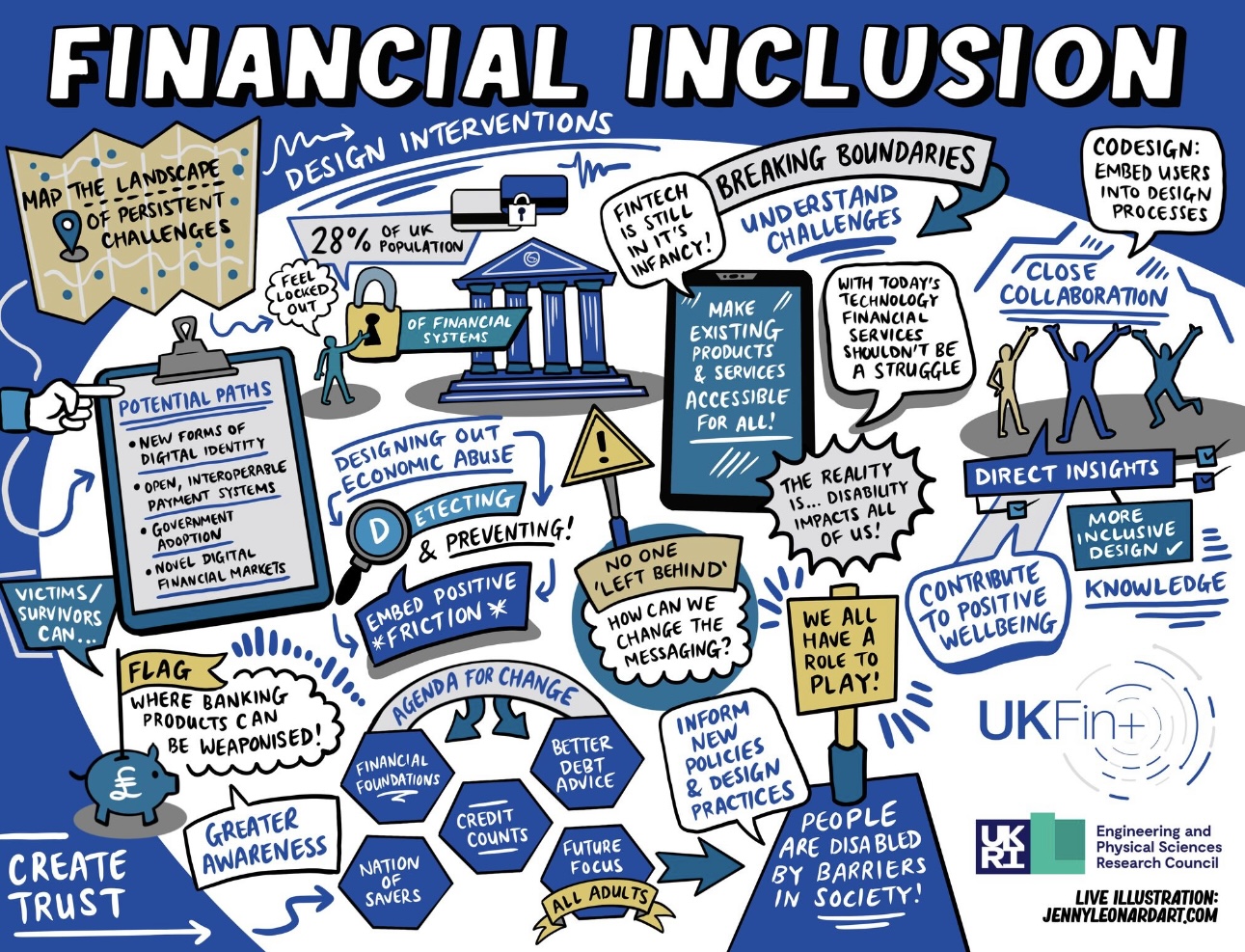
This was a cross-disciplinary event led by the UKFin+ Network. It brought together academics and stakeholders working on technology-facilitated inclusion within the financial services sector.
Presenters explored diverse issues, including:
designing out economic abuse in the UK banking industry (Clare Wiper, Northumbria University)
the impact of FinTech Apps on consumer wellbeing (Reinhard Weisser, University of the West of England)
co-creating inclusive future financial technologies with disabled communities (Arthur Theil, Birmingham City University)
designing age-friendly digital banking technologies (Nicholas Micallef, Swansea University).
representatives from over 20 organisations attended the event, including universities and financial services.
UKFin+ Research Showcase on Financial Inclusion infographic
Evidence Safari
(Participatory Design Sessions, Jan + March 2025)
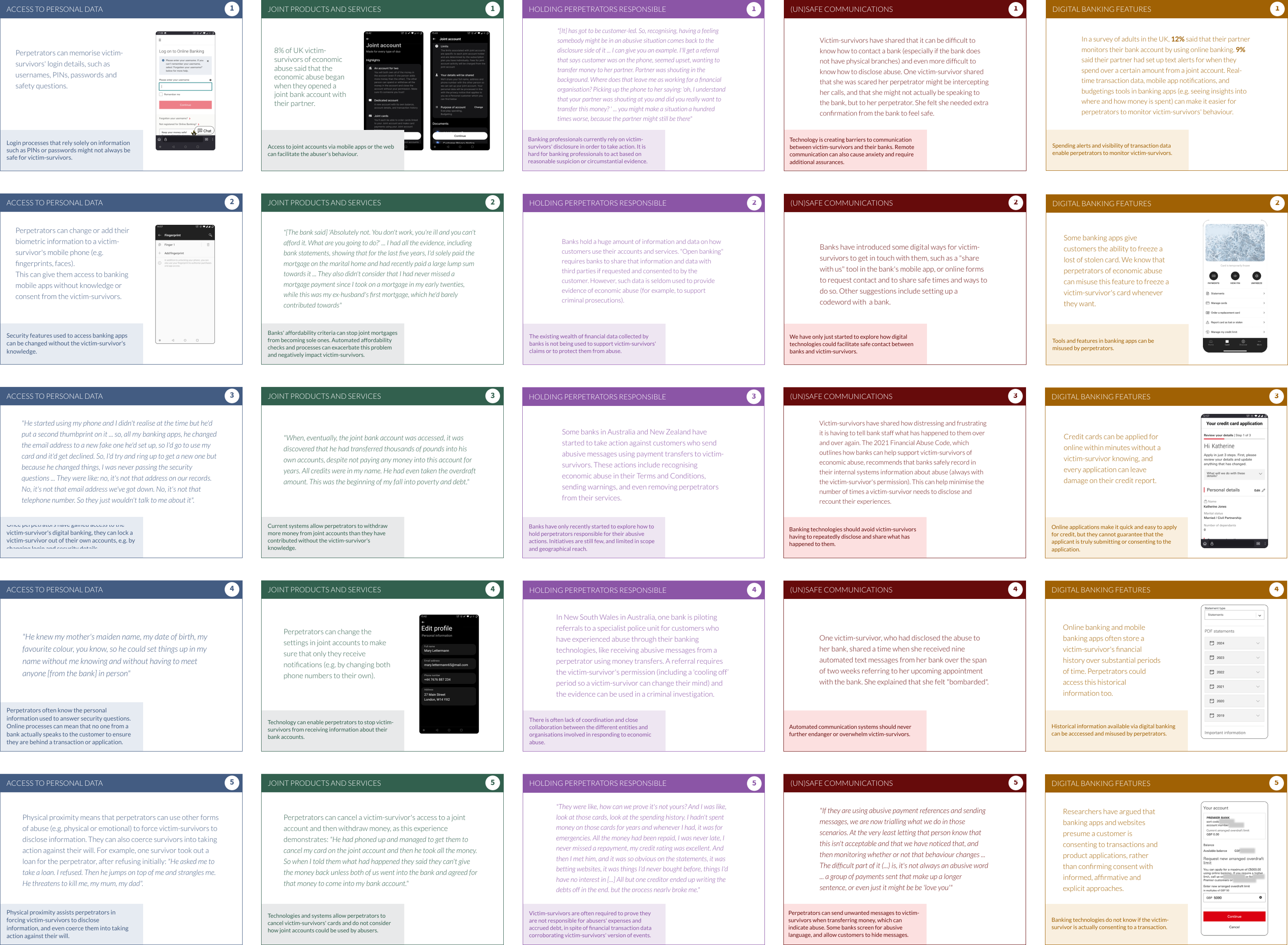
Victim-survivors and banking professionals worked together to analyse existing evidence about economic abuse, contribute their own insights, and highlight key challenges that must be addressed.
This was an interactive and collaborative session that explored the existing evidence base to generate new insights and understandings, which were then explored in more detail during later sessions.
Evidence Safari (Participatory Design Sessions, Jan + March 2025)
Mapping Victim-Survivor Journeys of Economic Abuse in Banking Contexts
(Participatory Design Sessions, Feb + April 2025)
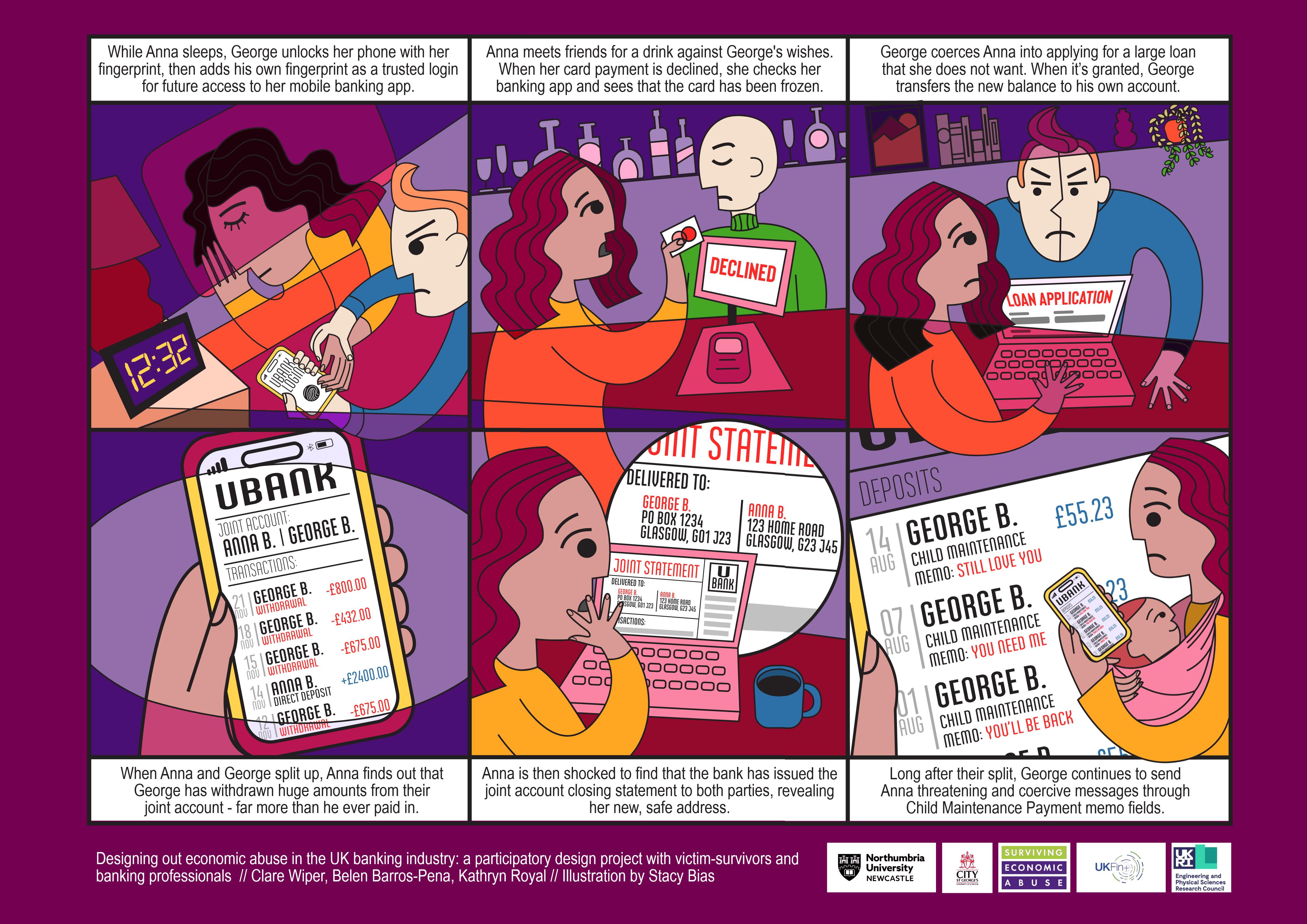
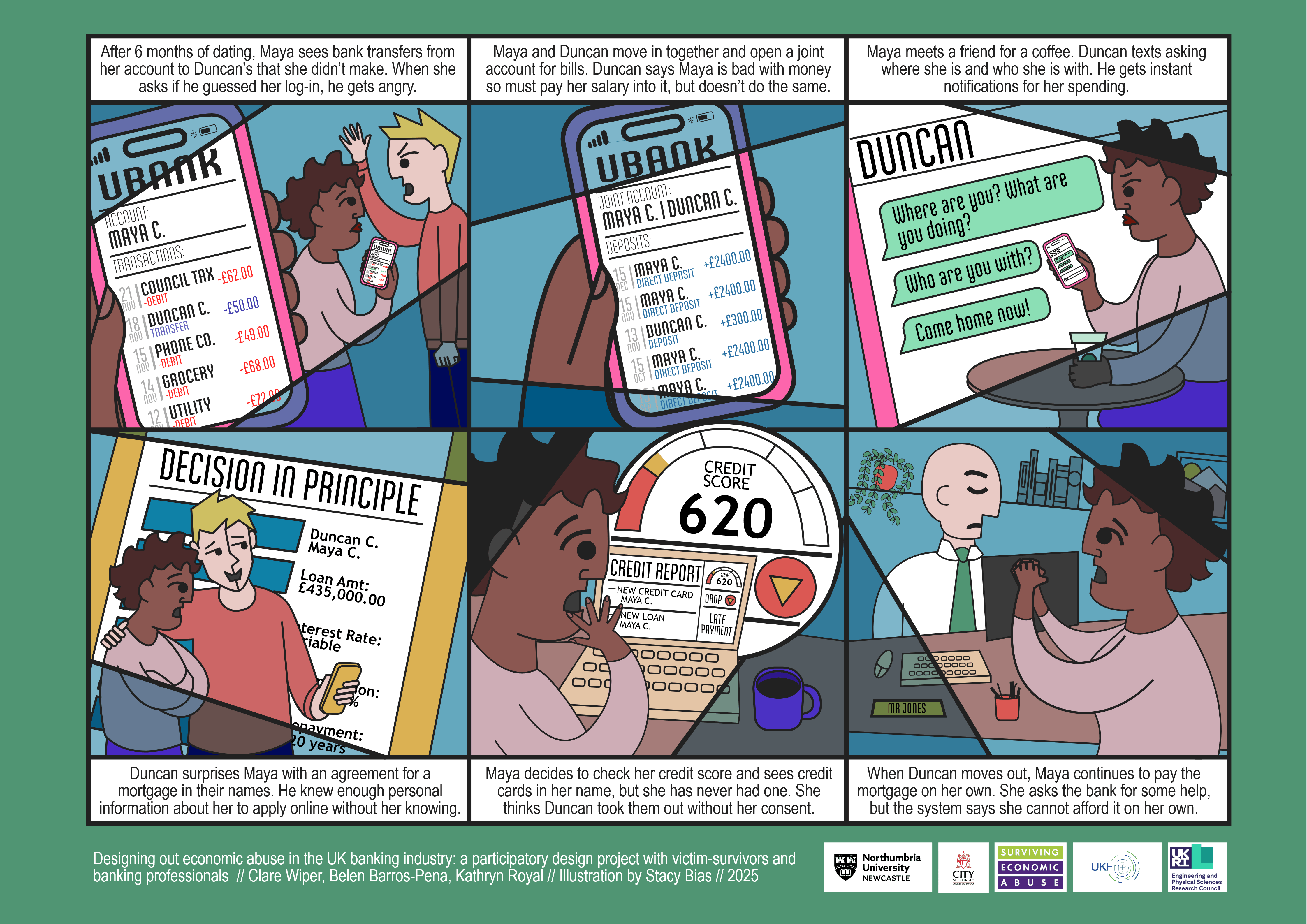
Victim-survivors and banking professionals reflected on how banking technologies are manipulated and weaponised by perpetrators to facilitate economic abuse. We presented each group with an illustration of a fictional victim-survivors’ journey through economic abuse. They were asked to reflect on how and why the perpetrator was able to weaponise banking technologies and services, and what banks could have done differently.
Victim-Survivor Journey - Anna and George
Victim-Survivor Journey - Maya and Duncan
Co-Designing Interventions to Prevent Economic Abuse
(Participatory Design Sessions, March + May 2025)
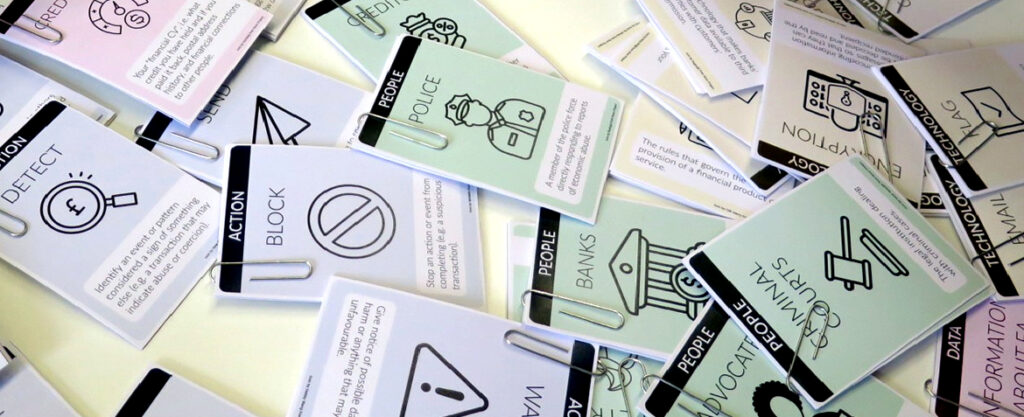
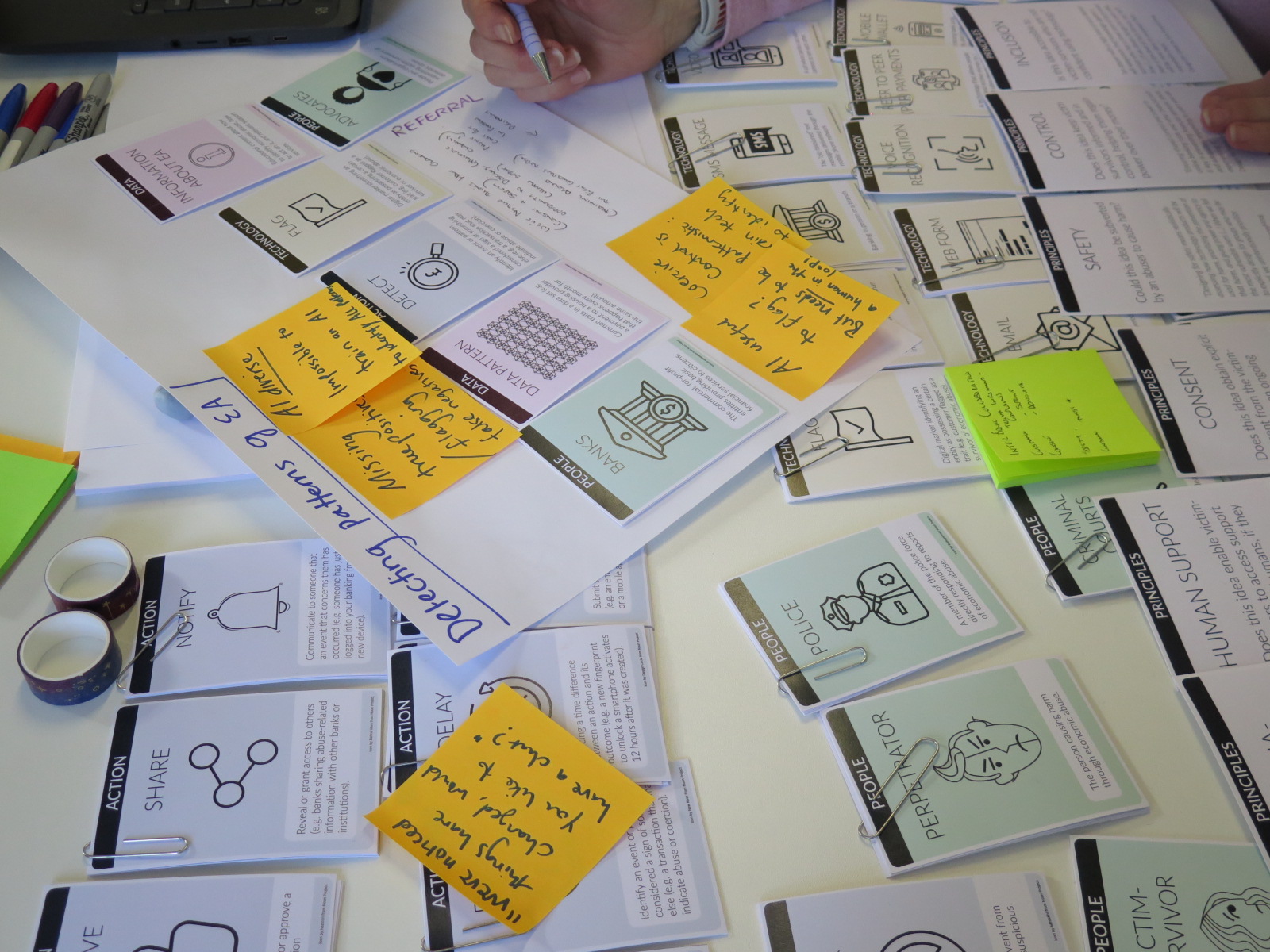
Victim-survivors worked with banking professionals to imagine new technological interventions that help prevent economic abuse in the banking context, and that support victim-survivors. The research team designed a set of cards that participants combined to create new interventions, and a set of safety design principles that participants could use to safety-check their ideas. We plan to create a toolkit in 2026 outlining the participatory design process, the cards and principles so that different research teams and organisations can use the materials.
Co-Designing Interventions to Prevent Economic Abuse
Design Prioritisation Session
(June 2025)
Victim-survivors voted on which interventions they would most like to see taken up by the financial services sector. During the session, we encouraged participants to discuss which interventions they felt were most impactful and feasible, and to vote accordingly.
The winning interventions were:
Detecting and Disclosing Economic Abuse
Joint Account Education and Protections
Both ideas were presented by victim-survivor participants at our stakeholder event in July 2025.
Winning Idea #1: Detecting and Disclosing Economic Abuse
Winning Idea #2: Joint Account Education and Protections
Designing Out Economic Abuse in the UK Banking Industry
(Stakeholder Event, July 2025)
Over 50 individuals attended our stakeholder event at Northumbria University’s London Campus, the majority of whom work for banks and other financial service organisations. The project team were joined by victim-survivor participants who advocated for the development of the shortlisted and winning ideas as open innovation initiatives for the whole of the financial services sector.
Attendees completed a short survey about the event. 100% of attendees strongly agreed / agreed that the event was interesting and that the ideas could make a positive difference for victim-survivors. 81% strongly agreed / agreed that the ideas are realistic to implement, and 78% strongly agreed / agreed that the methods adopted and design materials produced would be of interest to their organisation. Qualitative feedback included:
“Amazing event, absolutely fascinating and powerful method”
“Incredible and powerful piece of work – which has generated a lot of ideas!”
“Great collaboration with ideas that could make a real difference”
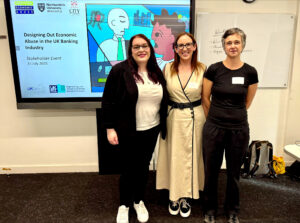
The project team left to right Kathryn Royal – Surviving Economic Abuse, Clare Wiper – Northumbria University, Belen-Barros -Pena City University
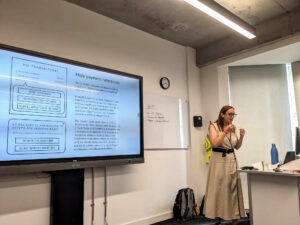
Presentation of project findings
Presentation of project findings
Final Report: Designing Out Economic Abuse in the UK Banking Industry: A Participatory Design Project with Victim-Survivors and Banking Professionals
(due August 2025)
This forthcoming report will outline the key findings and interventions emerging from the project.
Partners and Sponsors
City St George’s – University of London
Engineering and Physical Sciences Research Council
Surviving Economic Abuse
UK Fin+
Project classification
Project title is a Social Sciences project. It belongs to the following research clusters:
Staff in Humanities and Social Sciences at Northumbria University work with a wide variety of external institutions, organisations, and individuals and we are always keen to develop new partnerships and collaborations.
So, if you think there would be a benefit in working with us, or that our research expertise might be of use in your project or organisation, please get in touch to start the conversation.