

Project summary
People form judgements about others from the way they speak, yet listeners are often unaware of their deeply embedded ‘implicit’ biases.
Speaking of Prejudice is an ongoing research project encompassing a series of in-depth studies investigating deeply embedded (implicit) and self-reported (explicit) attitudes towards different accents spoken in the UK. A key objective of Speaking of Prejudice is to raise awareness amongst the general public and language policy makers of the social and educational implications of listeners’ explicit and more deeply embedded implicit prejudices towards different accents
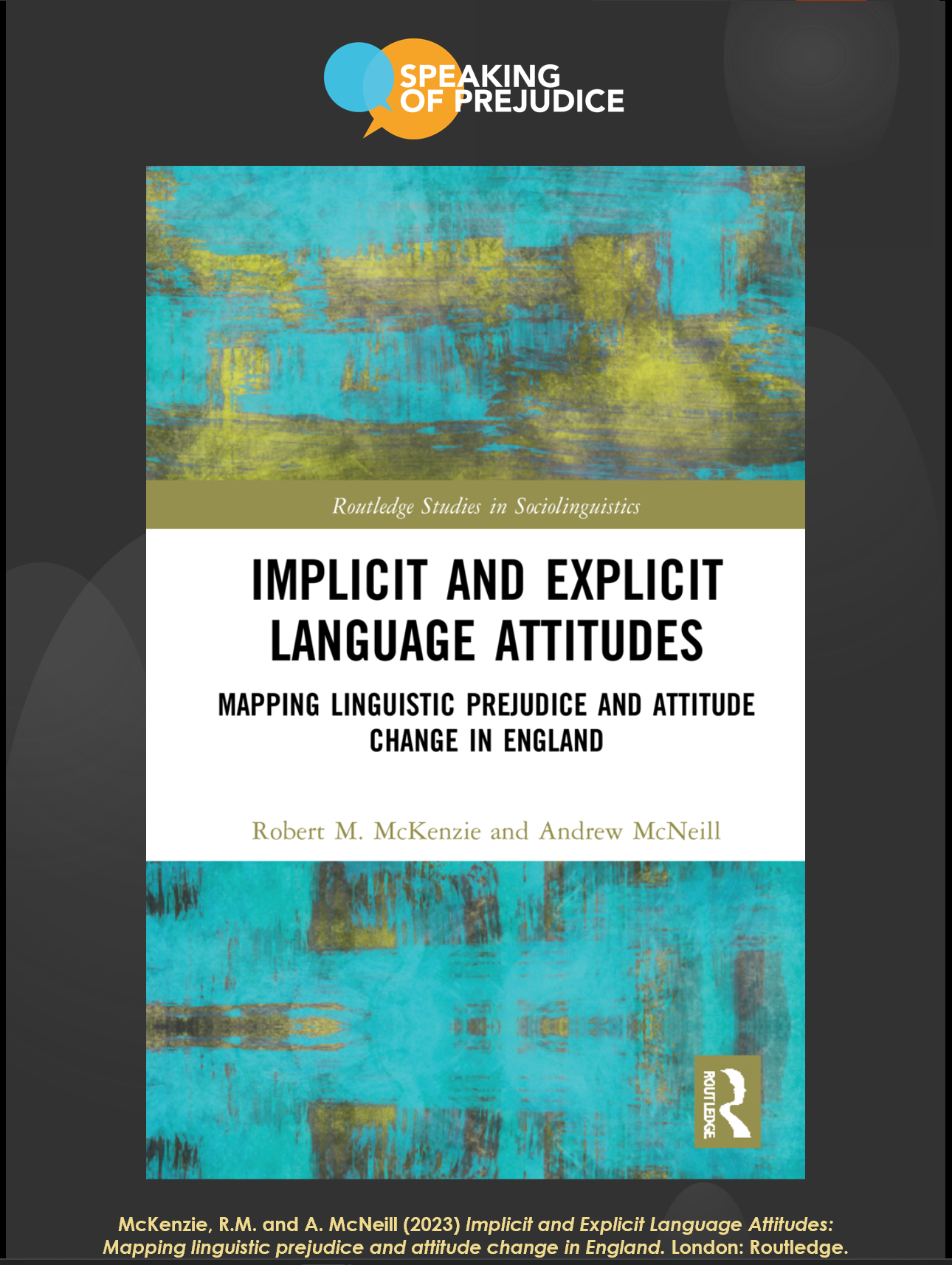
A recently completed major study, involving over 340 English nationals, examined implicit and explicit language attitudes towards the English spoken in the north and the south of England. Analysis uncovered evidence of language-based biases, especially against the status of Northern English and its speakers. The project results are detailed in the published research monograph:
McKenzie, R.M. and A. McNeill (2023) Implicit and Explicit Language Attitudes: Mapping Linguistic Prejudice and Attitude Change in England. London/New York: Routledge.
http://routledge.com/9780367703530
The current Speaking of Prejudice study extends prior research by investigating both explicit and implicit attitudes towards varieties of English spoken in Scotland.
Full project title
Speaking of Prejudice: Examining implicit and explicit language attitudes in England
Lead author
Project highlights
- Project website: Speaking of Prejudice website
- Twitter: @speechprejudice
Public Events
-
British Academy Summer Showcase Event (16 to 18/6/22), Trafalgar Square, London. Speaking of Prejudice was one of 12 public-facing research projects selected for public engagement exhibits – attended by several thousand school schoolchildren, VIPs and public
- Lit and Phil, Newcastle Upon Tyne. Public talk (26/11/21 sold out) and 70 audience member accent prejudice discussion, part of Winter Words Week ‘Accent Prejudice in Northern and Southern England’
- Cambridge University Student Union Debate (10/22) – invitation to debate on role of accent bias in ‘Challenging the Establishment’ theme
School Events
Northumbria University Press Release and Video Interview
Robert McKenzie discusses the social/educational implications of accent bias in the UK (15/6/22)
School Materials
Learning Resources -secondary school learning resources on language prejudice and language in society: Teacher and Student versions available for free download (and 350 print brochures) on accent prejudice
Tweet and correspond regularly on issues of language-based prejudice through Speaking of Prejudice @speechprejudice.
Universities HR
Inclusive Recruitment 2-hour online interactive ‘Inclusive Recruitment’ workshop (29/3/23), attended by approximately 30 HR professionals from universities throughout the UK. Presentation and discussion of implications of accent prejudice on university recruitment processes. ‘Speaking of Prejudice: Accent bias and its impact on recruitment’
Media
Newspaper interviews
- The Guardian (Mark Brown, 12/6/22) (reader comments now deleted)
- The Guardian (Kirsty Major, 3/11/22) (+ 2,342 reader comments)
- The Times (Kieran Gair, 14/6/22) (+ 848 reader comments)
Radio
- LBC (19/6/22, Sangita Myska) – live interview/ listener discussion
- Voice of Islam (Raza Ahmed, 20/6/22, Raza Ahmed) – recorded visual interview – 20/6/22
- BBC Radio 3 Free Thinking (John Gallagher 13/10/22) – live interview/BBC I-player podcast
Podcasts
- Lexis Podcast – interview (21/5/22)
- Northern Agenda Podcast (run by Manchester Evening News/Newcastle Chronicle– interview (26/6/22)
TV
GB News (12/6/22) – panel discussion of above Guardian article (+35 reader comments)
GB News (4/11/22) – appeared on Patrick Chrystys TV show
Project image gallery

Partners and Sponsors
Project classification
Speaking of Prejudice is an English project. It belongs to the following research cluster:
Want to put our research in YOUR world?
Staff in Humanities and Social Sciences at Northumbria University work with a wide variety of external institutions, organisations, and individuals and we are always keen to develop new partnerships and collaborations.
So, if you think there would be a benefit in working with us, or that our research expertise might be of use in your project or organisation, please get in touch to start the conversation.