Introducing our 2022 summer interns

This summer, we were very lucky to be joined by four summer interns, funded by Northumbria University’s Widening Participation employability scheme and by the Department of Humanities. In the coming weeks, each of them will contribute to or project blog individually, but here they are introducing themselves!

ALICE WILSON

What do you study, and why were you interested in this project? 

I have studied a Humanities undergraduate degree (English Literature and Creative Writing) and was interested in the project due to a module in third year which I loved (History, Myth, Narrative: Prose Writing About the First World War). I wanted to explore the niche and unacknowledged aspects of memory surrounding the conflict which I had become fascinated by. 

Tell us about one thing you found out as part of your internship. 

I have discovered there is a linear process within national memory of the war (as presented by the media) and during my research have found smaller, much more personal communities of remembrance that are often forgotten about by mainstream avenues. I have found wider representation a topic of continued personal learning, and revelations of individual perspectives during and after the conflict to be eye opening.   

What did you enjoy most about the internship? 

I have enjoyed the depth and variety of gathering information across different channels and applying my creative thought processes where research appeared to end or falter, by considering other alternatives and yielding results.  

Do you have a favourite kind of ephemera yourself? 

I am particularly intrigued by items that many may not consider as war ephemera at first glance; for example, one may see a helmet or an ammunition pouch, and automatically know it is an item from France between 1914-1918. Yet take a pair of fragile spectacles, and their case containing a name and date, and research determines they belonged to a nurse who tended to wounded soldiers from 1915-1917. There is an enduring story and personal perspective in such a seemingly homely or normal item. Those are the pieces of ephemera I prefer, the items that held immense value to an individual, and we future generations do not know it, until we discover their history.

FANNI PUTZ

What do you study, and why were you interested in this project? 

My name is Fanni, a second-year student at Northumbria University studying English Literature and Creative Writing. When I was informed about the advertised internship ’Ephemera and Writing about War in Britain, 1914 to the Present’ I was drawn to the idea of completing an internship within the Northumbria Humanities Department. I was interested because I am enthusiastic about researching everyday stories and objects of the First World War in Britain and working with professionals in the research field is an excellent opportunity to develop both personally and professionally. Undertaking research is one career in which I am interested following university, and interning as a Research Assistant helped me explore this interest.

Tell us a bit about what you did as part of your internship.

During the internship period, I had the chance to work with Dr Chris Kempshall and Dr Ann-Marie Einhaus, who were supportive and appreciative of my efforts. I got detailed feedback on my written work and suggestions about how could my piece be improved. Working in a team collaboratively was highly motivating as we had week by week meetings where we discussed our newspaper research findings. My first research topic was the Falklands War and I was assigned to do research in the Mirror and Daily Express. Then, I was assigned to do research in the Shropshire Star about the recent fall of Afghanistan to the Taliban coup.

What did you enjoy most about the internship?

The week by week meetings helped me to improve my communicational skills by discussing research findings in a professional and friendly environment. My writing and organisational skills have also developed by working to deadlines. I thoroughly enjoyed being part of a professional environment where I got all the help I needed to perform well and produce a quality work. However, I faced with some challenges during my internship. For example, finding the best peer-reviewed source, or relevant material that is published in a newspaper is quite challenging, firstly because newspapers are heavily biased by politics. So, filtering out relevant and reliable information was a challenge.

Do you have a favourite kind of ephemera yourself?

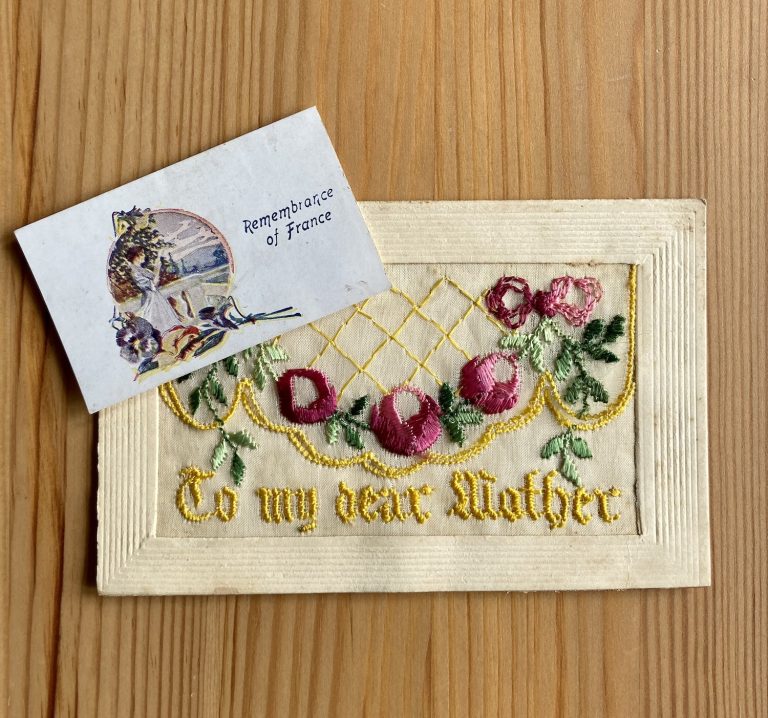
One of my favourite ephemera is a silk postcard from First World War. It is a colourful card with pink embroidered flowers with the subtitle ’To My Dear Mother’. The envelope coverage inscription states ’Remembrance of France’. It is very fastidious and of high standard. It is clear that it was made for a special loved one.

Silk postcard embroidered with ornamental pink flowers and the words 'To my dear mother' in ornate yellow script on lace, with a paper inset reading 'Remembrance of Frabce' alingside an image of a young woman kneeling among trees.

ELIZABETH BOWMAN


What do you study, and why were you interested in this project? 

Hello, my name is Elizabeth and I am a recent graduate from Northumbria University, having studied English Literature and History. I was interested in the project as it gave me the opportunity to combine both History and English literature disciplines (alongside creative writing which I do as a hobby), and continue to engage in close analysis of sources like I did for my dissertation.

Tell us a bit about what you did as part of your internship.

Through this internship, I was able to learn more about minorities and their experience of the First World War (particularly ethnic minorities). I was also able to expand upon my love of gender history in a new and different time period to my previous studies, having focused my research on the Early Modern period in the past.

What did you enjoy most about the internship?

In the internship, I most enjoyed being able to investigate a range of sources and engage with the material. I also loved the opportunity to create public outputs, which allowed me to utilise skills I learned through my university course alongside my more creative skills through writing a piece of fiction and crafting a twitter thread.

Do you have a favourite kind of ephemera yourself?

My favourite piece of ephemera was the piece that inspired my pieces of public output (a postcard from Egypt which blended race and gender history). I loved the opportunity to analyse both the image on the front and the text written on the back, and feel the two together offer a great insight into the period.

JOEL EVERETT

What do you study, and why were you interested in this project?

I’m going into my third year of studying English Literature, which obviously provided motivation and a general interest towards the literature-related aspects of the War Ephemera project. My interest in the project was further compounded by many instances of literary ephemera within the poems, such as letters from a loved one, or newspaper clippings.

Tell us about one thing you found out as part of your internship.

I found out that many trenches and divisions kept cats as pets, both to catch rats and as morale boosters. I ought to tell my cats back at home, next time they nag for more food.

Grey tabby with green eyes perched on a duvet and looking up at the camera
Joel’s cat aka research assistant

What did you enjoy most about the internship?

I got to engage with the poetry meaningfully, through repeated readings of, and engagement with, a wide range of each poet’s works. This way of engaging with the poetry created an intimacy that typical reading would not engage. I also got to discover a number of beautiful and moving poems that, otherwise, I would never have encountered.

Do you have a favourite kind of ephemera yourself?

There is a small toy fish that I keep with me at university, a silly-looking thing with pink hair and a big, red nose. It was one of my cat’s toys and it reminds me of her, so I keep it around regardless of its aesthetic quirks. I’m not sure if I’ll ever return the stolen goods, that little fish seems right at home with me.

Leave a Comment

Your email address will not be published. Required fields are marked *

Scroll to Top