
Resources
Podcasts
In our three podcasts we reflect on various aspects of our work on Desert Disorders.
In the Desert Disorders Project podcast, members of the project team (Katherine Baxter, Farhana Ibrahim, Deborah Sutton and Christina Woolner) reflect on their experiences of interdisciplinary collaboration.
In the Desert Disorders Ethics podcast, we turn our attention to the question of ethics in our project, thinking both about some of the practicalities of navigating institutional ethics processes as well as the different ethical considerations to which our interdisciplinary project gave rise (with Katherine Baxter, Farhana Ibrahim, Deborah Sutton and Christina Woolner).
In the Desert Disorders Sound podcast, Christina Woolner is joined by Sarah Jackson and Joanna Allen, who work at the intersections of poetry, sound and social ethnography. They discuss what sound means to them in their work across Somaliland, Western Sahara, the Kurdish Region of Iraq and their diasporas.
Image credits: Deborah Sutton and Katherine Baxter.
Intro credit: Katherine Baxter (sound recordings from Hargeysa and Delhi, with thanks to participants of the Desert Disorders symposium in Delhi).
Storyboards
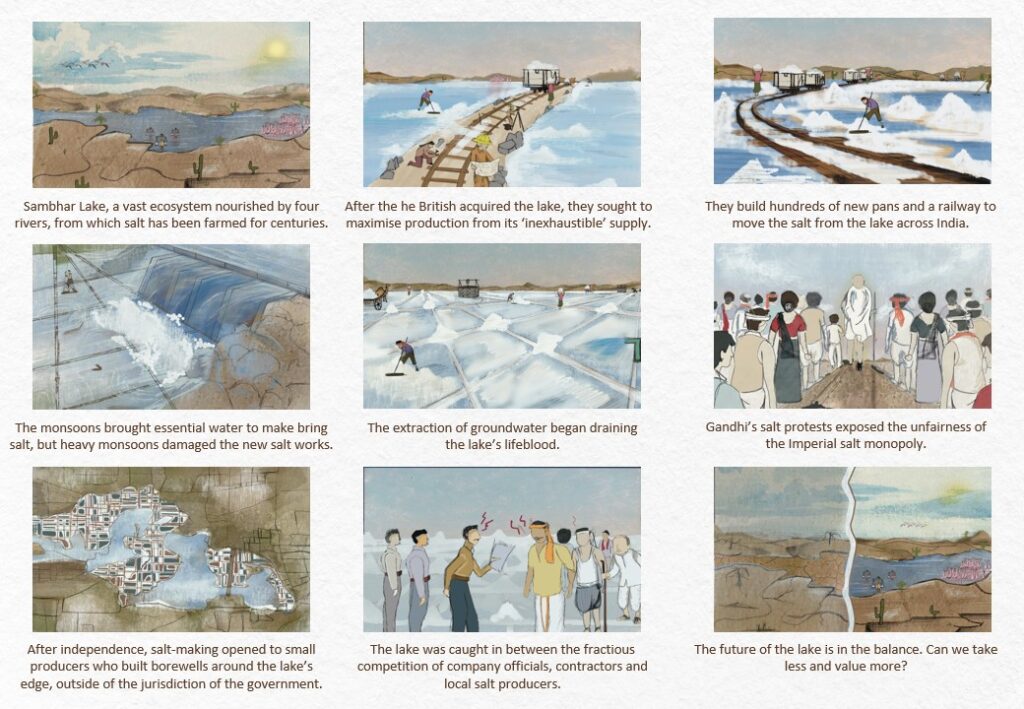
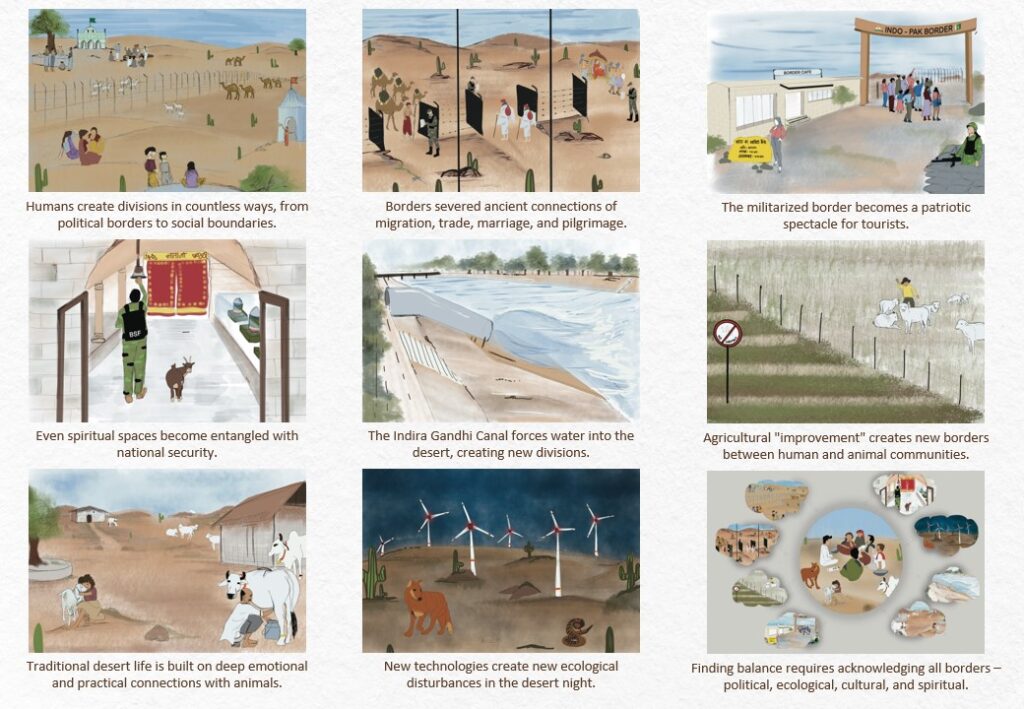
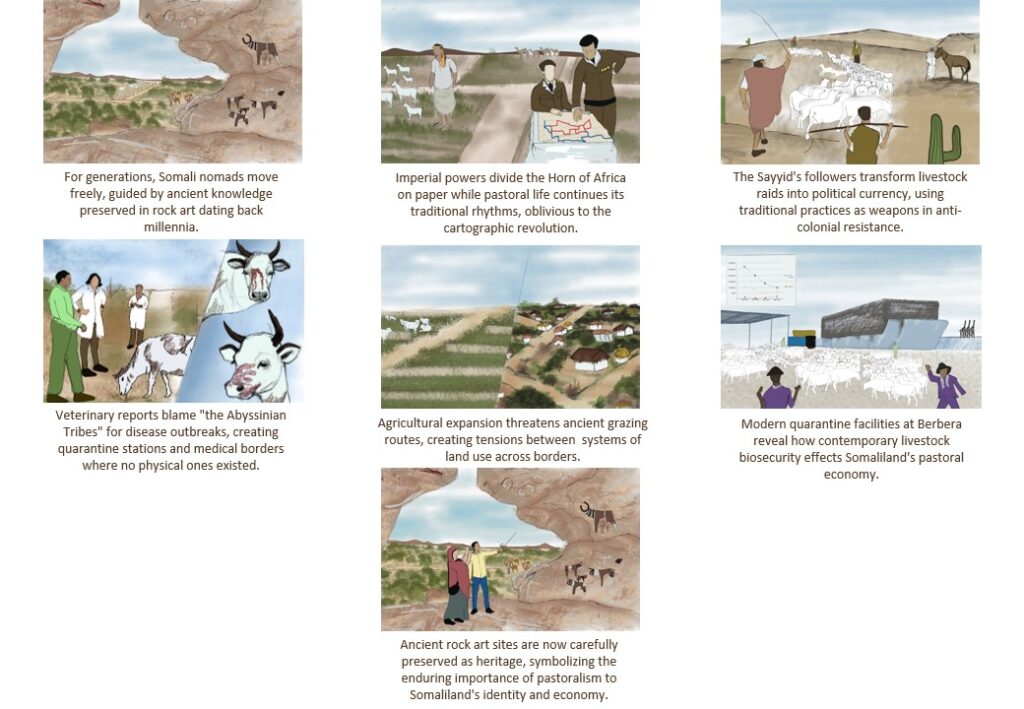
As part of the Desert Disorders Project, we worked with Sejal Changede (Lancaster University) to create a series of storyboards that illustrated our research findings. These storyboards reflect the project’s three research themes: Ecologies, Borders and Mobilities. As we discuss in the ‘Desert Disorders Project’ podcast, these storyboards emerged from our interest in exploring ways to communicate our research that challenged inherited discourses about arid and semi-arid regions.
Sambhar Salt Lake Ecologies - Sejal Changede and Deborah Sutton
Borders in the Thar Desert - Sejal Changede and Farhana Ibrahim
Somaliland Livestock Mobilities - Sejal Changede and Katherine Baxter
Publications
.In 1900, seven European nations gathered in London to agree the Convention for the Preservation of Wild Animals, Birds and Fish in Africa. The Convention sought to regulate game hunting across the African continent, in response to the decimation of wildlife that unregulated hunting for sport and ivory had caused. Six years later, Agnes Herbert and her cousin Cecily set out from London to British Somaliland on a big game hunt. In this article, I explore the interrelationships of memoirs, such as Agnes Herbert’s, with law and literary imagination in the creation of a colonial conservation culture. I do so by invoking Foucault’s thinking about heterotopias. I unpack the temporal modalities in which ideas about big game operate in administrative and literary texts: both the idea of a lost golden age and, more particularly, the futurities of big game that they construct and debate through ideas of “preservation.”
Coming soong
Coming soon
What we've been reading
Edited by Samia Henni. Columbia University Press, 2022.
‘Colonial and imperial powers have often portrayed arid lands as “empty” spaces ready to be occupied, exploited, extracted, and polluted. Despite the undeniable presence of human and nonhuman lives and forces in desert territories, the “regime of emptiness” has inhabited, and is still inhabiting, many imaginaries. Deserts Are Not Empty challenges this colonial tendency, questions its roots and ramifications, and remaps the representations, theories, histories, and stories of arid lands—which comprise approximately one-third of the Earth’s land surface. The volume brings together poems in original languages, conversations with collectives, and essays by scholars and professionals from the fields of architecture, architectural history and theory, curatorial studies, comparative literature, film studies, landscape architecture, and photography. These different approaches and diverse voices draw on a framework of decoloniality to unsettle and unlearn the desert, opening up possibilities to see, think, imagine it otherwise.’
Elizabeth A. Povinelli. Duke University Press, 2016.
In Geontologies Elizabeth A. Povinelli continues her project of mapping the current conditions of late liberalism by offering a bold retheorization of power. Finding Foucauldian biopolitics unable to adequately reveal contemporary mechanisms of power and governance, Povinelli describes a mode of power she calls geontopower, which operates through the regulation of the distinction between Life and Nonlife and the figures of the Desert, the Animist, and the Virus. Geontologies examines this formation of power from the perspective of Indigenous Australian maneuvers against the settler state. And it probes how our contemporary critical languages—anthropogenic climate change, plasticity, new materialism, antinormativity—often unwittingly transform their struggles against geontopower into a deeper entwinement within it. A woman who became a river, a snakelike entity who spawns the fog, plesiosaurus fossils and vast networks of rock weirs: in asking how these different forms of existence refuse incorporation into the vocabularies of Western theory Povinelli provides a revelatory new way to understand a form of power long self-evident in certain regimes of settler late liberalism but now becoming visible much further beyond.
Jaseon De Leon and Michael Wells, University of California Press, 2015
The Land of Open Graves reveals the suffering and deaths that occur daily in the Sonoran Desert of Arizona as thousands of undocumented migrants attempt to cross the border from Mexico into the United States.
Drawing on the four major fields of anthropology, De León uses an innovative combination of ethnography, archaeology, linguistics, and forensic science to produce a scathing critique of “Prevention through Deterrence,” the federal border enforcement policy that encourages migrants to cross in areas characterized by extreme environmental conditions and high risk of death. For two decades, systematic violence has failed to deter border crossers while successfully turning the rugged terrain of southern Arizona into a killing field. Featuring stark photography by Michael Wells, this book examines the weaponization of natural terrain as a border wall: first-person stories from survivors underscore this fundamental threat to human rights, and the very lives, of non-citizens as they are subjected to the most insidious and intangible form of American policing as institutional violence.
Judith Scheele Journal of African History, 51 (2010) 281-300 https://doi.org/10.1017/S0021853711000016
Studies of trans-Saharan trade have recently been revitalized, mainly through an exploration of local archives. These archives offer a further possibility: to investigate the link between local settlement and wider patterns of exchange. Material from southern Algeria and northern Mali suggests that oases were not viable without outside investment, that pastoral economies needed storage space and agricultural produce, and that intra-Saharan and trans-Saharan trade relied on each other. Hence, regional mobility and outside connections were not subsidiary but constitutive of the local, and local patterns of production and trans-Saharan commerce were aspects of the same system.
Rebecca Gruskin, Journal of Global History, 16 (2021) 315-35 https://doi.org/10.1017/S1740022821000097
Phosphates mined in France’s North African empire fed interwar Europe’s voracious appetite for chemical fertilizers. In critique of histories vesting commodities themselves with the agency to make the modern world, I trace not the substance but the value embedded within it. By following value, I argue that the ‘commodity’ is not a stable unit of analysis. Rather, commodities are multiform. They can acquire myriad properties when the value embedded within them changes across time and place. During the interwar period, phosphates’ character as a commodity transmuted in relation to flows of other goods, movements of labour, global financial exigencies and imperial considerations. As phosphates assumed new forms, the geographic scales over which they operated changed too. Through North African phosphates, I explore value-making processes that perpetuated capital-intensive farming, allowing for a history not of the commodity-as-substance but of the commodity-as-historical-object whose analytical boundaries and forms shifted across contexts.