
The long shadow of the dead
Split between national moments and localised activities, events organised during the centenary were often innovative and exciting. However, even at their most creative there was an ongoing tendency to reproduce commemorative and remembrance norms, particularly in the way that the focus has often fallen upon the dead rather than surviving participants.
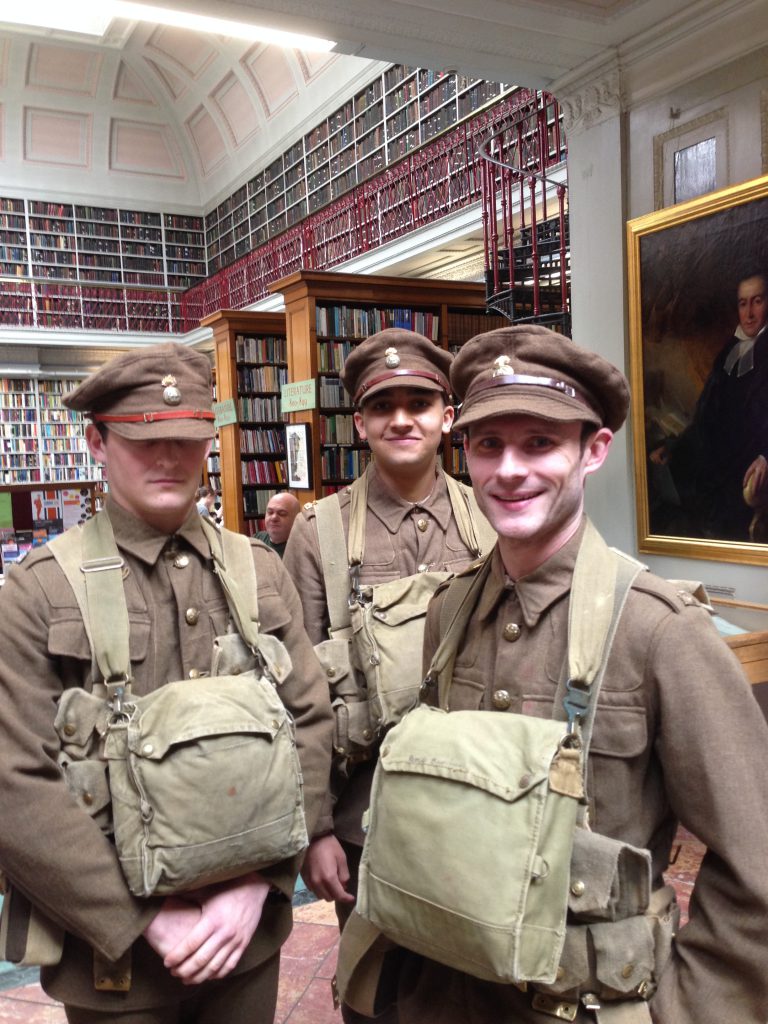
The art installation at the Tower of London, Bloodswept Lands and Seas of Red, saw ceramic poppies placed in the Tower’s moat, each one signifying a dead soldier from the British and Imperial forces. The innovative immersive art experience We’re Here Because We’re Here marked the centenary of the Battle of the Somme by young actors in period uniforms gathering at railway stations across the country, each one taking on the role of a soldier killed on 1 July 1916. Both projects, through their innovative approaches, had huge public impact and engagement but also highlighted in their own ways the shadow cast by fallen servicemen across the landscape of remembrance.
Whilst the focus on soldiers, and primarily those killed in action, was largely maintained through the centenary, this was not universally the case. The WW1 Engagement Centre Gateways to the First World War noted the eclectic mix of projects they supported during the period:
‘Most projects used local experiences of WWI as a starting point for research. Other projects explored British Empire experiences, medical histories, wartime industries, transport, childhood, experiences of women and ethnic minorities, sport, naval history, citizenship, religion, mental health, disability history, performance history and war legacies.’
Despite these examples, there existed a semi-overt hierarchy of experiences and remembrances before the centenary. Some of these were challenged and changed over the four years of activities, but some have endured beyond that.
‘Hidden’ histories, considerations, and our project
Santanu Das has reflected on the good work undertaken during the centenary to ‘change the colour’ of the way the war is remembered. This has been achieved, in his view, by focusing ‘on experiences of non-white colonial troops had broadened understanding of lesser known aspects of the First World War. Examples of increased visibility in Australia include memorials to indigenous service and a separate banner at Anzac Day marches.’
Such work to spread the centenary’s focus beyond the experiences of white British soldiers can also be seen in a variety of local endeavours such as the Frehom Foundation that examined the impact of the war on Malawi, and the installation of blue plaques in Seaford, East Sussex to mark the experiences of West Indian soldiers who trained there.
Issues regarding the political landscape of Britain and Ireland also complicated some centenary activities. In her 2017 article reflecting on the centenary activities in Ireland, Catriona Pennell noted that ‘there have been an extraordinary range of local initiatives’ dedicated to commemoration of the First World War in both the Republic and Northern Ireland. The 2014-2018 stood in the middle of the ‘the decade of centenaries’ and ‘was an event that could be comfortably understood by both unionists and nationalists’. The centenary could potentially serve as a platform for further reconciliation activities in Ireland, though Pennell also, understandably, voices her discomfort at being caught between ‘the dissemination of complex and nuanced history’ and a commitment to ‘peacebuilding’.
Whilst efforts were made to broaden commemoration activities out to include more diverse communities and audiences, these were often considered in relation to the term ‘hidden histories’ which, as the Teaching and Learning War Research Network report explains, is problematic:
‘One of the most prominent aspects of the debate concerned the definition of “hidden”. While it was perceived that commemorations of the First World War centenary has done a lot in terms of achieving visibility of the racial component of the term, more should have been done to include stories about, and perspectives of, those who may remain hidden on the basis of gender, sexuality, class, ethical persuasion (e.g. conscientious objectors) or political struggle taking place in parallel with the conflict. It was pointed out that the reasons for some stories remaining ‘hidden’ could have been due to hiding family histories that jarred with “integrationalist” narratives, or having them purposefully taken away, due to the internal conflicts such as those in Northern Ireland.’
The terminology of ‘forgotten’ or ‘hidden’ histories has become so pervasive in relation to the First World War that it has moved into cliché. However, when applied to the experiences of those who exist outside of mainstream commemoration the term ‘hidden’ suggests a passive process that ignores the relationships between historical remembrance and social power structures. ‘Hidden’ can just as easily be understood as ‘suppressed’ or ‘erased’.
Where do we go from here?
Drawing upon the work of Catriona Pennell & Ann-Marie Einhaus’s First World War in the Classroom Project, historians Anna Maguire and Diya Gupta have noted that ‘many secondary school-level History and English teachers struggled with teaching colonial experiences of the world wars’. Their approach stemmed from an understanding of ‘both “the continued inability (or refusal) to confront a history of imperial exploitation and racial hierarchy”, and also the lack of familiarity with source material pertaining to colonial experience’.
The centenary started a process of expanding the national and local focuses in relation to wartime interactions, experiences, and memory. But there remain those from communities – specifically south-east Asian, African, West Indian, and Irish – who for a variety of reasons have not yet been given the benefit of full participatory status.
The availability of sources can hinder any form of historical analysis or platforming and is something we hope to remedy with our project. But further to this the analysis and showcasing of imperial histories of the World Wars should not hinge on a refusal by educators to confront histories of imperial exploitation or racial hierarchy.
Finding out how to uncover these stories, materials and experiences and give acknowledgement and space for those who keep them, is a key focus for our project. Through doing this we aim to widen access to historical spaces for those who were overlooked during the centenary.