
Introducing the First World War centenary in Britain
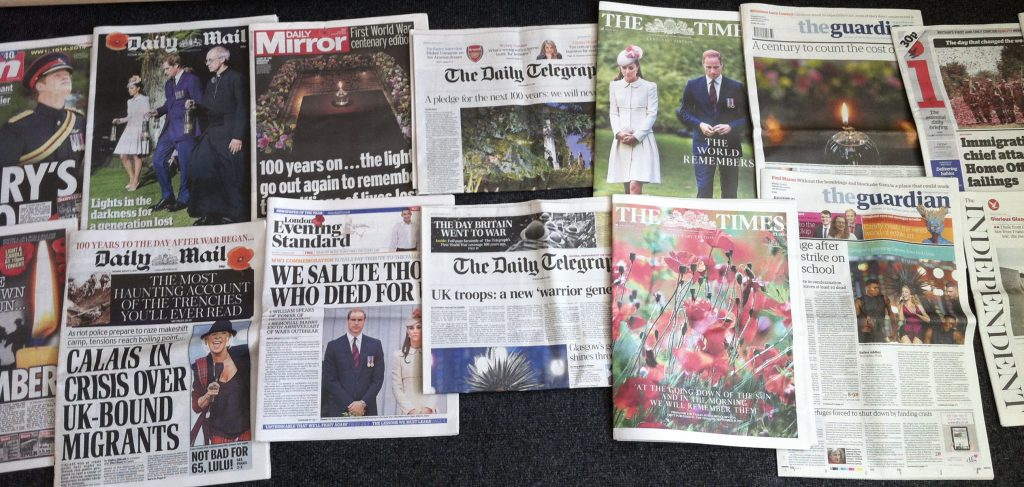
Between 2014 and 2018, the United Kingdom entered a prolonged period of national commemoration and remembrance to mark the centenary of the First World War. The initial announcement for the centenary commemorations was made by the then Prime Minister, David Cameron at the Imperial War Museum in October 2012.
The governmental involvement with the centenary was organised by the Department of Culture, Media and Sport (DCMS). The Imperial War Museum was the central institution for centenary commemorations and the government funded 14-18 NOW project facilitated much of the artistic responses.
However, this was not simply a centenary run and organised centrally through governments and established institutions. Many activities of the centenary period were organised by non-governmental groups, local institutions, and individuals.
To understand these activities and evaluate not just the ‘successes’ or ‘failures’ of the centenary but, more importantly, the gaps which our project is attempting to fill, it is necessary to understand what the centenary was designed to achieve, and how the various activities came into being.
National Plans, Intentions, and Infrastructure
On a national level, particular moments within the First World War were identified as being suitable focal points for commemoration. These were the outbreak of war in 1914, the Battle of the Somme in 1916, and the war’s conclusion in 1918. These moments would be commemorated in 2014, 2016, and 2018 respectively. In his 2016 article Something About Who We Are as a People’: Government, Media, Heritage and the Construction of the Centenary, Daniel Todman theorised that these centenary events would likely be all that the public could manage and the danger of ‘remembrance fatigue’ may have an impact the longer the centenary lasted.
The 2014-2016-2018 framework was not the totality of centenary activities. For example, the centenary of the Battle of Passchendaele was commemorated in 2017. Other moments of the war were commemorated at local levels based on connection and relevant links.
Various organisations provided support to facilitate local endeavours and artistic interactions with the centenary. The aforementioned 14-18 NOW project aimed to ‘support the creation of artworks by contemporary artists, to engage and stimulate the UK public in fresh and engaging ways that will lead to new perspectives on the First World War and its resonance today’ and centred much, but not all, of its focus on the 2014-16-18 framework.
Katherine Baxter, a colleague at Northumbria University, scrutinised the advantages and limitations of the 14-18 NOW approach in a series of interviews with artists and curators, with particular attention to the implications for diversity of representation. Her findings are available in her Open Access article Practices of Remembrance: The Experiences of Artists and Curators in the Centenary Commemoration of World War I.
Local dimensions
To support local communities’ own activities during the centenary the Heritage Lottery Fund (HLF) made a variety of grants available for those who met wide-ranging criteria. The two broad aims of HLF’s FWW Centenary-related activity were:
- To fund projects which focus on the heritage of the First World War and collectively:
- create a greater understanding of the First World War and its impact on the range of communities in the UK;
- encourage a broad range of perspectives and interpretations of the First World War and its impacts;
- enable young people to take an active part in the First World War Centenary commemorations;
- leave a UK-wide legacy of First World War community heritage to mark the Centenary;
- increase the capacity of community organisations to engage with heritage, and to raise the profile of community heritage.
- To use the Centenary projects that HLF funds to communicate the value of heritage, the impact of our funding and the role of HLF.
To assist in the activities of the HLF various ‘WW1 Engagement Centres’ funded by the Arts and Humanities Research Council (AHRC) were established within university networks. These centres would ‘provide UK-wide support’ for projects financed by the HLF.
Funding the centenary
All of these projects and undertakings required a great deal of financial backing. At the launch of the centenary planning in October 2012, David Cameron announced there would be £50m of funding made available for the commemorations. However, Todman has indicated that, in real terms, central government only invested an additional £10m at this point. By contrast, the HLF had awarded £97.5m to First World War centenary projects by 28 February 2019.
While some of this money was used for large-scale undertakings, such as a £15m grant for the refurbishment of HMS Caroline as a museum ship, the post-centenary report by DCMS outlines that this was not the norm:
The vast majority of projects have been funded through our ‘First World War: then and now’ grants programme, which has so far awarded £14.8m to 1,754 community projects, all receiving grants between £3,000 and £10,000.
The outcome of this was an ongoing process of decentralised commemoration activity during the centenary that, at least ostensibly, aimed to reflect the interests and objectives of the public.